

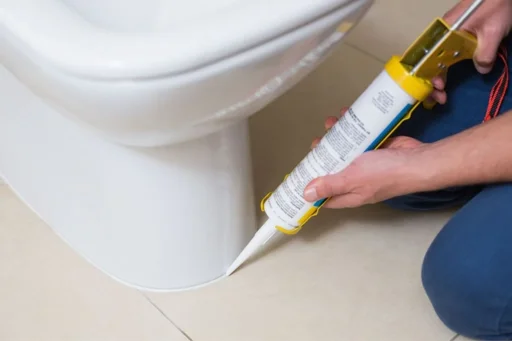
I’m currently thinking no caulk is best because it allows you to notice if the wax ring is leaking. In fact, this is exactly what happened to me recently. I flushed and noticed water coming out from the sides of the toilet.
What do the fedinauts think?
From the article:
However, leaks are usually noticed from the floor below the toilet when looking up. Leaks under the tub are often found in the same way. In apartments, it is common for the tenant below to be the one who first notices a problem. So this argument for not caulking is somewhat flawed.
This seems like a terrible reason to caulk. The first obvious major flaw with this thinking is that it assumes you have a lower floor??? I only have 1 floor and then it’s concrete below. I can’t notice it from the bottom. Also, if you’re in an apartment, wouldn’t it still be better for the owner to notice the leak from the toilet, instead of waiting for it to get so bad the the person from the bottom notices??
Caulk prevents water from seeping under the toilet.
OK. This I guess makes sense, for certain people, I guess. If your shower or sink is right next to your toilet, I could see water from the outside going in. But in my case, my toilet is not near sinks or showers. So I’m a lot more worried about water from the inside going out.
Caulking around the toilet is good for pest prevention
I guess I can understand this point. Small bugs could hide under the toilet.
Caulk looks better
Disagree.
and helps prevent unpleasant odors
Why would there be odors? The wax ring and the toilet should be making a good seal, no? If there are odors, doesn’t that mean the seal is failing? Wouldn’t that be a sign you should investigate further? Not hide the issue?
Plumbing codes require caulking a toilet to the floor
Because I said so isn’t a good reason…
Pro caulk:
- could prevent bugs from hiding under the toilet
- could prevent water from going under the toilet
Con caulk:
- hides wax ring failures
- hides poor installation
Seems like the cons carry waaaayyy more weight than the pros.
You must log in or register to comment.
If you have floating flooring in your bathroom don’t caulk, it will move and separate. Ask me how I know. 🙃
What’s floating flooring?
Floating floor planks. Generally wood laminate / artificial planks that sit on top of existing flooring or subfloor, and generally click together at the sides and ends. They’re pretty common for newer homes and for cheaper floor replacements.
They’re not a bad option. They’re cheap and benefit from individual planks being relatively easy to replace if damaged, but the drawback is they tend to shrink and expand a bit and can shift with temperature and humidity fluctuations.
I have floating floor in my home and every few months as the temp and humidity changes occur with the seasons have to use a suction gripper and mallet to knock closed gaps in a few places where they can shift anywhere from 1/16 to up to 1/4 inch if/where the ends have separated in places. But it means caulking under the toilet was a bad move because they’re designed to be able to shift slightly, and sealing them down that way can cause issues and eventually the seal will break from the pressure of the planks shifting. And doing it caused a few gaps to form where there were none previously.
I’m not a big fan of this flooring application, and am considering going with glue down engineered wood in the future when it needs replacing.
TIL, thanks! I do have flooring I have to install soonish… It seems DIY-friendly so that’s interesting. Although, hm. Not sure about the drawbacks. Good to know about.
Take the drawbacks with a grain of salt, I’ve seen good professional installations, a lot of buildings in my area (both residential and commercial) use this kind of flooring. The good stuff is durable, can look really nice and hold up well with lots of foot traffic and doesn’t need the extra maintenance when done right. But you gotta pay more for the better stuff, like anything else.
My house was custom built on a reasonable budget during the pandemic, “builder’s special” kinda thing. We made it work, but there were definitely corners cut in places. Some things are quality, some things are cheap but work, and I guarantee the flooring was one of the things they cheaped out on. 😅
Plumber of 12 years here, mostly in North America but also did a year in western Europe. Caulk or no caulk is situational.
In residential situations (houses or apartments) I prefer to do the no caulk method. When homeowners see water, they generally realise there is a problem and they call a plumber before the floor rots out; if the toilet is caulked, the standing water can do a shit ton of damage before it gets noticed. Also, silicone / caulk gets nasty looking very quickly without regular cleaning. I only ever installed wall-hung toilets in Europe, and we caulked the bowls but they generally never leak so it’s less of an issue.
In commercial situations, like public bathrooms, I’ll caulk the bowl, leaving a small gap at the very back so that a leak can potentially be detected. These types of installations are almost always on some type of concrete and tile floor, so damage to the floor is much less likely to occur. Also, those toilets take muuuch more abuse than one in a residential home, so the layer of caulk helps secure the toilet from displacement. Additionally, most public bathrooms are cleaned on a (hopefully) regular basis, so the caulking tends to stay a little less nasty looking.
I was always told if you caulk to leave the back open so leaks and smells can be noticed. So, it’s mostly for looks. Some local codes might require it though, so check if your local code was amended.
I have seen aquarium sealant (pure silicone, the clear stuff that smells like vinegar) be used around the flange to seal up any gap between the flooring and the closet flange which prevents leaks from wetting the subflooring and causing it to rot out.
If you have an uneven floor (bad tiles/old house etc) and you don’t trust shims to hold forever, you can also seat the toilet on plaster of Paris; just leave the back open so leaks can’t build up but again this is only necessary in unusual cases.
TLDR; if you don’t prefer the look and it’s not a code requirement and you are confident that you can achieve a solid mount, you can skip it.
pure silicone, the clear stuff that smells like vinegar
I believe the stuff that smells like vinegar is special sanitary caulk for bathrooms which comes with anti-fungal properties. Pure silicone is odorless, not for bathroom use, IIUC.
We don’t use “wax rings” here. Leak from the sewer connection is virtually impossible. I’ve been doing plumbing for 15 years and I’ve never seen or heard it happen.
The toilet is attached to the floor with adhesive and then it’s made pretty by caulking the seam. In some apartment buildings they want a little gap left into the adhesive and caulking to let out any water that might get under there when washing the space but this is rare and is almost never done.

