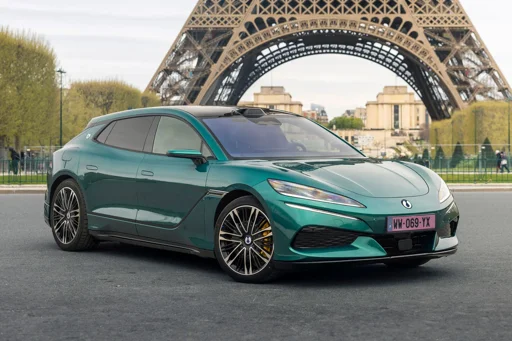
The chargers will be open to every car manufacturer and will use the universal CCS2 charging infrastructure.
This is very impressive, I just saw a Youtube video from Sweden about how insanely fast these new BYD cars charge 10-70% in 5 minutes!!!
Meanwhile the new Tesla model Y that supposedly charge at 250 kWh, has one of the worst charging curves in the market, and drops off to only 100 kWh already at 35% charge level!!
The new Tesla cars are actually worse than the old ones, because Tesla is using their own inferior battery design made for the Cybertruck, that Elon Musk used to rave about how amazing would be, but gave them so many problems to manufacture, and apparently this never got completely solved.
Anyone who think Tesla is still a market leader or even just still a good option must be unaware of how bad Tesla is now compared to the competition. Tesla did some cool things early on, but they are nowhere near what their marketing is claiming.
Pushing 1.5kW is going to get dangerous when the chargers and cars age.
Is it actually “pushing”? I’ve always thought the consumer is “pulling”.
Yeah, devices pull power.
The charger periodically tells the car the maximum power it can provide, and the car knows to not ask for more than that (plus the charger will just cap it at its max).
Apart from that, it’s mostly like a regular electrical outlet. If you plug in a 50W desk fan, it’ll only pull 50W, even though the outlet can provide 1800+W
Do they come with a nuclear power plant embedded? Jokes aside, how is the electricity network going to handle such loads?
You have to consider that the amount of power needed is the same, it is just delivered quicker for the individual car.
But spread among thousands of cars it all evens out, making the power delivery required mostly the same.
Slower charging just means more cars are charging at the same time, and 50 cars charging at a lower rate is the same as 10 cars charging 5 times as fast, but also only a fifth of the time.So for the network it’s the same, it’s only for the individual charger that there’s a real difference.
No, it’s most definitely not the same for the network. The sizing of everything in electrical infrastructure - generators, transformers, cables, protection devices - is bound to the current going through them. When you deliver the same energy in a much quicker time, you can only do so by increasing the current. Which means that, unless people are charging in low demand hours (e.g. at night), your infrastructure will either buckle or “shed loads”. Load shedding is when a circuit is dropped to prevent the overall network to brownout. Better not place the chargers in the same circuit as hospital and homes for the elderly!
False, the chargers have transformers, and I bet charging stations with 20+ chargers have local transformer stations too.
For one transformer station to supply for instance 12 chargers at 100 amps each or 4 at 300 amps each is both 1200 amps.When you deliver the same energy in a much quicker time
You obviously completely failed to understand my explanation that this is not what is happening on the scale of charging stations with many available charging slots.
Obviously these 1,5 MWh charging stations will not be availbale at you local grocery store, they are part of bigger installations with probably already around 20 charging slots of 300-400 kWh charging capacity.
Probably the same way it’s handled when someone builds a new factory.