I think you’re right in that an ICE vehicle with similar specs would be worse off. Also, I think there’s an error regarding the stated output of the engine. Official sources are showing a much higher rated output of 13.5kw.
It still seems underpowered if it is intended to carry 6 adults uphill at 50 kph. Regardless of torque, power is the rate at which work is done. It can be expressed as the resistive force times the velocity. I can’t find a weight for the vehicle, but based on vehicles with similar specs, I’ll guess it’s well over 700kg. Moving 700kg up a 6-degree slope, which is still a pretty reasonable grade, at 50kph would require over 13kw and that’s the theoretical max, without passengers, headwinds, etc. No way is the Olinia 1 doing 50kph uphill with 6 adult passengers.
Perhaps that’s not the problem it’s designed to solve, though. Maybe it’s okay if it slows down to 25kph, carrying 6 adults, because it’s navigating an urban environment. If the point is efficiency in city commuting, this could be a viable addition to the array of solutions for displacing fossil fuels.
Your original comment just sounds like a lack of experience with electric vehicles. Simply put, EV and ICE are fundamentally different power trains. Routing a comparison through HP is exactly what someone familiar with ICE but not EV is exactly what you would do if you know traditional cars, but it doesn’t map to EV’s in how they work in the real life.
And honestly, at the price we could probably buy one, find six lemmings in Mexico and a decent hill and just run the experiment.
The comment to which you’re replying is my original comment.
Nothing in it is intended to be pro ICE or anti EV.
This doesn’t have anything to do with something as abstract as engineered systems. It’s basic physics. You can’t get 15kw out of something with a max output of 14kw. That’s just axiomatic.
Doesn’t matter if it’s ICE, EV, horses, flywheels powered by suspended weights, steam turbines powered by fusion, etc. It’s just not possible to move a mass at an angle and velocity such that one of those variables increases without also increasing the power. These are some of the assumptions on which EVs are built. And they’re constantly validated by testing and everyday EV (and ICE) driving experiences.
I sincerely hope this project succeeds for all the right reasons. I’m not advocating for the preservation of ICE vehicles and infrastructure. My concern here is STEM literacy among advocates of progressive solutions. I would very much like for us to be taken seriously, and I think that requires communicating our position and intent effectively.
We don’t have a misunderstanding. You made a reductive argument, got challenged, and now you’re acting like invoking “basic physics” makes the engineering irrelevant.
Run your own scenario honestly. Holding 50 kph up a 6-degree grade with six adults is a high sustained wheel-power demand. If a vehicle only has 14 kW of continuous usable wheel power, ICE or EV, it probably is not doing that.
But that does not make the powertrain irrelevant. That is exactly the point you keep missing.
In an ICE vehicle, the rated power depends on RPM, gearing, transmission losses, and whether the engine can stay in its power band. In an EV, usable output depends on the motor, controller, battery, thermal limits, gearing, and peak-vs-continuous power. Those are not interchangeable systems just because the same physics applies to both.
So no, reducing the question to horsepower does not make sense. Reducing it to torque does not make sense either. That is just car-brained ICE framing.
The powertrain design is the point. Treating ICE, EV, horses, and flywheels as interchangeable for a real vehicle-performance question is not STEM literacy.
The right answer here is to buy one of these, for both of us to go to mexico and make two freinds each, go to an appropriate hill, and give it a shot.
Sure, but there’s still a floor defined by physics. With the right setup, it could lift 5000lbs up a cliff. But it might take a year and hundreds of recharges.
Yeah. That’s the entire point. The engineering changes the experience drastically.
You can’t just say watts are watts and be done with it. Its a reductive approach to do so.
Yeah but the point is given a certain amount of watts, there’s a maximum speed to lift no matter what the setup is. And it doesn’t matter whether you measure that power in Watts, horsepower or Pferdestärke - the maximum speed to lift a given weight is the same.


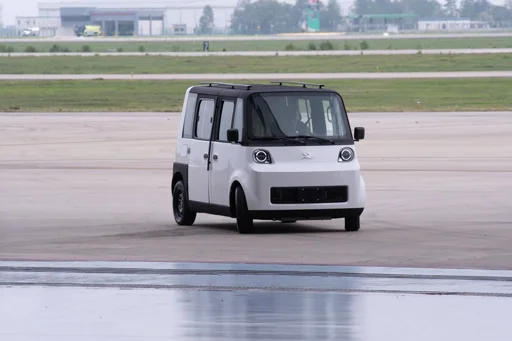
I think you’re right in that an ICE vehicle with similar specs would be worse off. Also, I think there’s an error regarding the stated output of the engine. Official sources are showing a much higher rated output of 13.5kw.
It still seems underpowered if it is intended to carry 6 adults uphill at 50 kph. Regardless of torque, power is the rate at which work is done. It can be expressed as the resistive force times the velocity. I can’t find a weight for the vehicle, but based on vehicles with similar specs, I’ll guess it’s well over 700kg. Moving 700kg up a 6-degree slope, which is still a pretty reasonable grade, at 50kph would require over 13kw and that’s the theoretical max, without passengers, headwinds, etc. No way is the Olinia 1 doing 50kph uphill with 6 adult passengers.
Perhaps that’s not the problem it’s designed to solve, though. Maybe it’s okay if it slows down to 25kph, carrying 6 adults, because it’s navigating an urban environment. If the point is efficiency in city commuting, this could be a viable addition to the array of solutions for displacing fossil fuels.
Your original comment just sounds like a lack of experience with electric vehicles. Simply put, EV and ICE are fundamentally different power trains. Routing a comparison through HP is exactly what someone familiar with ICE but not EV is exactly what you would do if you know traditional cars, but it doesn’t map to EV’s in how they work in the real life.
And honestly, at the price we could probably buy one, find six lemmings in Mexico and a decent hill and just run the experiment.
We might have a misunderstanding here.
The comment to which you’re replying is my original comment.
Nothing in it is intended to be pro ICE or anti EV.
This doesn’t have anything to do with something as abstract as engineered systems. It’s basic physics. You can’t get 15kw out of something with a max output of 14kw. That’s just axiomatic.
P = Fv cosθ
https://www.tutorchase.com/notes/a-level-ocr/physics/6-3-2-mechanical-power-from-force-and-speed
Doesn’t matter if it’s ICE, EV, horses, flywheels powered by suspended weights, steam turbines powered by fusion, etc. It’s just not possible to move a mass at an angle and velocity such that one of those variables increases without also increasing the power. These are some of the assumptions on which EVs are built. And they’re constantly validated by testing and everyday EV (and ICE) driving experiences.
I sincerely hope this project succeeds for all the right reasons. I’m not advocating for the preservation of ICE vehicles and infrastructure. My concern here is STEM literacy among advocates of progressive solutions. I would very much like for us to be taken seriously, and I think that requires communicating our position and intent effectively.
We don’t have a misunderstanding. You made a reductive argument, got challenged, and now you’re acting like invoking “basic physics” makes the engineering irrelevant.
Run your own scenario honestly. Holding 50 kph up a 6-degree grade with six adults is a high sustained wheel-power demand. If a vehicle only has 14 kW of continuous usable wheel power, ICE or EV, it probably is not doing that.
But that does not make the powertrain irrelevant. That is exactly the point you keep missing.
In an ICE vehicle, the rated power depends on RPM, gearing, transmission losses, and whether the engine can stay in its power band. In an EV, usable output depends on the motor, controller, battery, thermal limits, gearing, and peak-vs-continuous power. Those are not interchangeable systems just because the same physics applies to both.
So no, reducing the question to horsepower does not make sense. Reducing it to torque does not make sense either. That is just car-brained ICE framing.
The powertrain design is the point. Treating ICE, EV, horses, and flywheels as interchangeable for a real vehicle-performance question is not STEM literacy.
The right answer here is to buy one of these, for both of us to go to mexico and make two freinds each, go to an appropriate hill, and give it a shot.
Sure, but there’s still a floor defined by physics. With the right setup, it could lift 5000lbs up a cliff. But it might take a year and hundreds of recharges.
Yeah. That’s the entire point. The engineering changes the experience drastically. You can’t just say watts are watts and be done with it. Its a reductive approach to do so.
Yeah but the point is given a certain amount of watts, there’s a maximum speed to lift no matter what the setup is. And it doesn’t matter whether you measure that power in Watts, horsepower or Pferdestärke - the maximum speed to lift a given weight is the same.
Do you drive an EV?
Yes, sometimes. My wife’s car is a Tesla 3. And yes the feel is very different. But the bottom line physics is still the same.