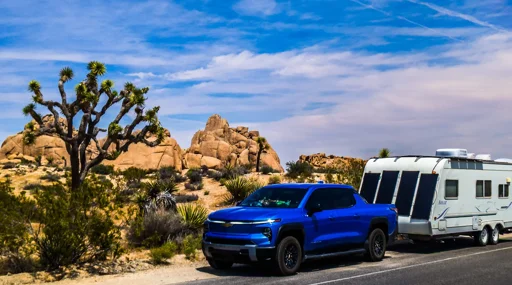
Support CleanTechnica's work through a Substack subscription or on Stripe. A couple of years ago, I wrote an article titled “We May Have Been Wrong To Mock GM’s Big Battery Approach To Electric Trucks.” Back then, it was incredibly easy to point and laugh at vehicles like the Hummer EV ... [continued]
60-80 miles!? What kind of vehicle are you talking about? Towing a trailer can vary quite a bit but it’s generally ~50% of normal range. So in a 300 mile vehicle, that’s 150 miles, or 2.5 hours of driving.
This article is shit. I tow 9,000lbs fine in my EV and get about 1.25mi / kW.
The charging infrastructure does, indeed, suck. 10000%. But that’s America. With careful planning I’m not stopping for more than 20-30 minutes which gives me time to get snacks, stretch, and use a bathroom.
In my own use, I’m never towing further than needing to stop 1-2 times so it’s fine.
I don’t need to read the article to know how far an EV will go while towing, I have first and second-hand experience. I have a friend who uses their Lightning to tow boats on a daily basis.
100 to 0% gets you 300 miles.
Peak charge speeds are only 10-80%.
Headwinds matter a lot. Stay above 20% for safety.
Now your only have 60% of your battery available for each leg.
That 300miles is now 180.
Half that is 90miles. Best case.
Real world? Yah, 60-80 miles available between charges.
Any decent trip planner is going to account for headwinds.
Headwinds are a weather thing. They can change dramatically at any moment. Trip planers only guestimate that kind of thing. And with a trailer having the arodynamics of a kite, they have a much greater effect on the trailer.
The 10% arrival accounts for margins of error in those calculations.
Only given the make and model you entered. The flying rectangle you’re towing isn’t part of those calculations. So it’ll have additional drag from the start, eating up that margin of error quickly.
It’s a gusstimate until you start driving. Then it might get real time data from the vehicle performance, not the weather. And only if you can give it access to the vehicle data. If the guesstimate is too far off, and there aren’t any closer chargers, your route planer gets you stranded.
In the article they discovered this, and had to give the route planner false data until its guesstimates lined up with their real results.
It’s a gusstimate until you start driving. Then it might get real time data from the vehicle performance not the weather.
Wrong. It gets it from weather reports. If they used something else in their testing, that’s their mistake, and no one will force you to make it as well.
Our first trailer got about 1.0 miles/kWh towing at 65 mph (our ABRP reference figure). When we swapped to the 7,000-pound inTech, our efficiency dropped down to 0.9 miles/kWh. If you are doing the math at home, 0.9 miles/kWh means a 130 kWh battery pack (the standard “extended range” packs you find in trucks like the F-150 Lightning or Rivian R1T) will give you about 117 miles of total range from 100% to completely dead. A Tesla Cybertruck’s 123 kWh battery does a few miles less.
But out in the real world, you never drive from 100% to 0%.
If you had read the article, you’d also have second hand experience that 80 miles is the appropriate real-world range for towing RVs.
How many miles per kwh do you get while towing at highways speeds, and how big is your battery? The article has reported that experience, so feel free to counter with your numbers, but saying “nuh uh” doesn’t contribute to the discussion.


60-80 miles!? What kind of vehicle are you talking about? Towing a trailer can vary quite a bit but it’s generally ~50% of normal range. So in a 300 mile vehicle, that’s 150 miles, or 2.5 hours of driving.
This article is shit. I tow 9,000lbs fine in my EV and get about 1.25mi / kW.
The charging infrastructure does, indeed, suck. 10000%. But that’s America. With careful planning I’m not stopping for more than 20-30 minutes which gives me time to get snacks, stretch, and use a bathroom.
In my own use, I’m never towing further than needing to stop 1-2 times so it’s fine.
Did you read the article?
You should read the article.
This article is shit
I don’t need to read the article to know how far an EV will go while towing, I have first and second-hand experience. I have a friend who uses their Lightning to tow boats on a daily basis.
Okay then. Let me summarize.
100 to 0% gets you 300 miles.
Peak charge speeds are only 10-80%.
Headwinds matter a lot. Stay above 20% for safety.
Now your only have 60% of your battery available for each leg.
That 300miles is now 180.
Half that is 90miles. Best case.
Real world? Yah, 60-80 miles available between charges.
Headwinds don’t always exist, and you have neutral and tailwind too, you can’t just assume that for the entire time
You don’t assume. You plan for. In case
Peak charge rates vary by vehicle, but most are <10%
You may have missed that we were discussing faster charging speeds.
Any decent trip planner is going to account for headwinds. The 10% arrival accounts for margins of error in those calculations.
Headwinds are a weather thing. They can change dramatically at any moment. Trip planers only guestimate that kind of thing. And with a trailer having the arodynamics of a kite, they have a much greater effect on the trailer.
Only given the make and model you entered. The flying rectangle you’re towing isn’t part of those calculations. So it’ll have additional drag from the start, eating up that margin of error quickly.
All of this was covered in the article.
Trip planners do not “guesstimate”, they tap into realtime data.
The trailer is covered in the estimate as well.
Once again, I don’t need to read a third hand account about this. I’ve lived it.
It’s a gusstimate until you start driving. Then it might get real time data from the vehicle performance, not the weather. And only if you can give it access to the vehicle data. If the guesstimate is too far off, and there aren’t any closer chargers, your route planer gets you stranded.
In the article they discovered this, and had to give the route planner false data until its guesstimates lined up with their real results.
Wrong. It gets it from weather reports. If they used something else in their testing, that’s their mistake, and no one will force you to make it as well.
From the article:
If you had read the article, you’d also have second hand experience that 80 miles is the appropriate real-world range for towing RVs.
That is absolutely incorrect. I have towed 9,000lbs numerous times and yielded 225-250mi of range.
I will agree that the Ford Lightning and Cybertruck are garbage though.
If you had read my comment, you’d know that I have lived this experience, and no, it isn’t.
How many miles per kwh do you get while towing at highways speeds, and how big is your battery? The article has reported that experience, so feel free to counter with your numbers, but saying “nuh uh” doesn’t contribute to the discussion.
So their experience counts but mine doesn’t?
Yes, if they describe their numbers but you refuse to describe yours.
I’ve already described mine above. If you choose to just ignore that, that’s your problem.